Barriers to Awakening
Mapping the bars to our mental prisons

Many of us who don’t tend to believe mainstream media narratives regularly encounter incredulity and resistance, even occasional outright hostility. What drives this? Everyone knows that politicians won’t honour their election promises, but what stops people questioning other things they say or questioning the media? This article aims to steer clear of specific conspiracies and instead look at the psychological barriers involved.
For each of those, I’ll suggest possible approaches to circumventing that barrier and still making progress. One overarching piece of advice would be: stick to what’s easy to understand and prove. If you stray too far from either of these, it’ll be even harder next time.
You don’t believe in any conspiracy theories? You just think the government’s just batting 1,000 and telling us the whole truth? That’s a strong stance to take! - Ron Funches
Conspiracy Theories and Conspiracist Thinking
The terms ‘conspiracy theory’ and ‘conspiracy theorist’ are routinely used to discredit those who question official narratives, and there may even be some validity to this argument.
A 2021 study entitled “Maybe a Free Thinker but not a Critical One: High Conspiracy Belief is Associated With low Critical Thinking Ability” found that people with lower critical thinking ability were more likely to believe “conspiracy theories.” Why might that be? To find out, we need to look at what they call a “conspiracy theory.”
The Generic Conspiracist Beliefs (GCB) Scale
The gold standard for measuring belief in conspiracy theories is the Generic Conspiracist Beliefs (GCB) scale. This asks 59 questions to asses how likely someone is to believe in conspiracy theories.
At first glance, there appear to be gaping holes in the methodology of this study, but some of this may be due to how we define a “conspiracy theory.” There are several cases where the actor, action & motive are conflated. Let’s look at some of the questions as examples.
20. Certain world leading political figures who died untimely deaths were in fact “taken out” by government operatives
This removes the possibility of outside contractors performing the work.
1. Certain celebrities and/or public figures actually faked their own deaths in order to escape the spotlight
This assumes that the motive is “to escape the spotlight.”
25. Secret organizations communicate with extra terrestrials, but keep this fact from the public
If it’s possible to communicate with extra terrestrials, what if it’s not secret organisations doing it, but government agencies?
3. Groups of scientists deliberately attempt to create panic about future risks because it is in their interests to do so
Do you have to believe that it’s scientists who seek to create panic?
68. Members of a secret group have infiltrated governments and powerful organizations in order to 1 day bring their group to the point of global control
This one presupposes the timing of events. Given George Washington’s bust in Houlton, Maine, one could be forgiven for wondering which came first.
Conspiracy Theory Summary
The problem with our definition of “conspiracy theory” is that, in real life and in these studies, it offers a pre-packaged view of the world, which may or may not be wholly or partially correct. So, what this gold standard measures is not someone’s propensity to believe in conspiracies, rather their willingness to unquestioningly embrace a pre-packaged theory, complete with actor, action & motive. It’s little wonder that those people rank lower in Critical Thinking Ability.
As you can see, questioning the official narrative is something different from believing in large conspiracies. For example, wondering whether Nigel Farage is exaggerating the small boat crisis doesn’t necessarily mean you believe he’s a shape-shifting lizard from another planet. Let’s not add to this conflation here.
So, let’s examine some distant history of conspiracy theories...
Plato’s Cave
Plato’s Allegory of the Cave comes from his ~375 BC work The Republic and discusses the distinction between appearances and real forms.
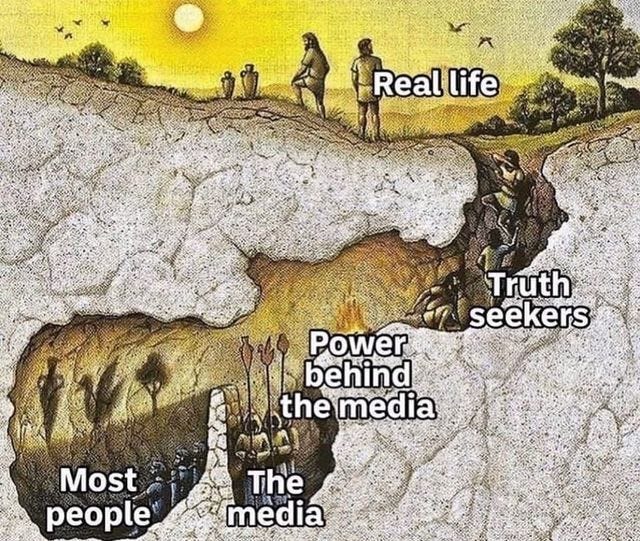
He describes the world we see as shadow puppets on a cave wall. All conversation and opinion centres around the assumption that the shadows represent real life. Anyone who escaped the cave and described what they saw “behind the curtain” or out in the real world would be considered crazy. It would be unfathomable to those watching the puppets.
This functions as an accurate metaphor for life as we’re living now. Anyone presenting evidence from behind the cave wall or out in the real world - or theorising about what might be there - would be disbelieved. It’s just too far removed from what they already believe to be true.
Plus ça change, plus c’est la même chose.
Tenets of Our Illusion
Our childhood experience is shaped to imbue two particular beliefs, which combine to form our view of the world.
Truth Comes from Authority
From 4 or 5 years old, children are sent to school. Here, they are taught that whatever the teacher says is true, and they’re tested & rewarded for that. They’re also taught that government statements and statistics can be relied upon.
More recently, the government announced a plan to help students identify “misinformation”. This will “scrutinise newspaper reports, comparing their style and language to fake news” and “be taught how to identify fake news websites via their designs.” In short, a biased view that promotes form over substance. The truth is the truth, even if it’s scribbled on a beer mat. This plan will further reinforce the idea that truth comes from the government and mainstream media.
It’s widely accepted that politicians lie, but when these politicians get together to form a government, we consider them an authority. How logical is that?
Heroes & Villains
Even before boys and girls go to school - before they can even read for themselves - their stories revolve around heroes and villains. There’s always a bad guy and, when there is, a hero comes along to save everyone (or at least the damsel in distress). Sometimes, the hero is known at the beginning of the story and sometimes he just appears, but he’s always there.
As such, the desire to believe in a hero is ingrained in us from an early age. This leaves us open to exploitation by wolves in sheeps’ clothing. Vladimir Lenin once said: “The best way to control the opposition is to lead it ourselves.” Few stop to question whether the person saying all the right things will actually do the right things. Orwell’s 1944 work Animal Farm illustrates one example of this problem.
In your life, how many people do you know who were saved by someone who couldn’t identify with them? That is, outside family, friends, witnesses? From an evolutionary standpoint, we help those in whose success we have a vested interest. How many of your heroes would lose sleep if something happened to you?
The Hurdles
Interest & Incentives
In Plato’s cave analogy, the observers simply aren’t aware of their situation. Like the proverbial frog in boiling water, they won’t realise until it’s too late. David Icke (one wolf in sheep’s clothing) dubs this “the totalitarian tip-toe.”

Even those aware that something needs fixing are kept busy by their careers, other responsibilities, and hobbies, so investigating the problem seems relatively unimportant.
Even if someone can’t accept the scale of the deception, most can be persuaded that deception exists in some cases. Eventually, they may be able to see the broader picture.
Cognitive Dissonance
The truth of an event can be so different from what people believe to be true, about history and the present, that they can’t accept it. People tend to reject information that doesn’t fit their existing world view, except when circumstances force them to.
With these people, it helps to start with smaller, individual lies (like “if he stabbed her, why is there no blood on his knife?” or “<male celebrity> is looking very feminine nowadays”).
Peer Pressure
Peer pressure takes multiple forms. One of the principal ones is communal reinforcement. If the majority of a group believes something, others tend to follow. The Brain Games Conformity Waiting Room experiment demonstrates this. Actors all stand when the beep goes off. After a time, the test subject does too. Once she does, further test subjects follow.
The Asch conformity experiments tested whether a test subject would be asked to look at a line and say which of a set of three lines was the same length. If everyone else gave the (obviously) wrong answer, 74% would still go with the group. How many do you think would agree, if disagreeing with the group required any research? Fortunately, if only one other person gave the correct answer, only 5% went with the (incorrect) majority.
In social situations, if a subject comes up, be that person who calmly cites evidence to the contrary. It only takes one.
Identity
A person’s identity is, simply, the collection of beliefs about themselves that they hold dear in any given situation. Labels form a strong part of the identity: “I’m a Christian,” “I’m a Muslim,” “I’m a Democrat,” “I’m a Republican,” “I’m British.” Identity Process Theory explores what happens when these are challenged. Once something forms part of someone’s identity, it can be nigh on impossible to challenge without fierce resistance. This is why groups love demonyms and other labels.
Put simply, a Christian would be more willing to accept that 9/11 was an inside job than God didn’t exist (hypothetically, of course). A Brit would be more likely to accept that Hitler was evil than Churchill.
Steer clear of challenging part of their identity, unless you have to. They’re more likely to believe facts about another demographic to start with, before they can accept that their group might also be involved.
Group Identity
This is even more tricky than dealing with aspects of identity or simple peer pressure. People are very reluctant to think ill of their group’s beliefs, when their group forms their emotional or financial support system.
If a person’s involvement in a group depends on their belief, you’re better off challenging other beliefs first. If they really need to break from that group, they’ll need an outside support system first.
Idols & Emotional Connections
Chinese researchers - in Breaking up with my idol - examined the complex nature of idolatry. They found that the barriers to renouncing fandom were “cognitive dissonance, emotional attachment, behavioural dependence, and social threat.” These may sound familiar. They’re almost identical to the problems associated with individual & group identity (in the case of fan clubs).
Here, try not to start by criticising their idol directly. They’re much more likely to believe similar things about their idol’s enemy (e.g. Trump or Biden) or assistant (e.g. Dick Cheney) than their idol himself.
Ego & Humility
Discovering the truth means a willingness to accept that you’ve been wrong, possibly for your whole life. You might have made significant decisions with real world impact based on lies. Some people’s egos have trouble accepting this idea.
Avoid directly implying that they’re wrong. Instead, you can diffuse responsibility with phrasing like “people believed...” Knowing that they’re not alone can help ease the acceptance process.
Weaponised Empathy
Propaganda exploits our emotions and empathy. For example, the infamous babies on bayonets campaign reported that Germans were bayonetting babies, to drive support for World War I. The thought of children (or women) being hurt affects us more than any other incident, as it does with members of our own groups (Christians, Brits, etc). Challenging these beliefs evokes some of the strongest reactions: “but three children were stabbed!”
It’s easier to start with topics that don’t have the same level of emotion attached (e.g. events outside their lifetime or country). To discuss the event itself, it’s easier to start with small parts of tangential evidence, like “how did that passport survive intact?” or “why did that tower fall straight down, not to the side?”
Conclusion
This is almost certainly not exhaustive, but I hope that helps to explain the complex nature of what we’re dealing with. It gets even trickier to deprogram people in group situations, where you need to consider the identities of everyone in the group simultaneously.
With any luck - and some tact - the suggestions here could prove to be practical and successful.